Use cases: Connected Health, Modernization, Single View
Industries: Healthcare, Life Sciences
Products: MongoDB Atlas, MongoDB Atlas Charts, MongoDB Time Series, MongoDB Queryable Encryption
Solution Overview
Healthcare providers operate under strict quality requirements. Federal agencies and insurers, including the CMS and major health plans, require providers to measure, track, and report the quality of care they deliver to patients. Compliance with these mandates carries financial consequences, such as higher reimbursements for organizations meeting these standards, and penalties for those that don't.
HEDIS defines the quality requirements. This measurement set specifies the clinical activities that providers must complete for each patient, for example, an HbA1c, a kidney evaluation, and a diabetic eye exam for diabetic patients. When a patient does not receive a required activity within the measurement period, a care gap opens.
Care gaps are not just a compliance problem. Left undetected, they lead to worse patient outcomes, higher hospital readmission rates, disease progression, and preventable complications. They also result in lower CMS Star Ratings and lost reimbursements under contracts where providers get paid based on patient outcomes, rather than the volume of services delivered.
Most organizations know care gaps exist. However, they face an operational challenge. While FHIR data stores allow medical software and EHR systems to securely communicate and share data, they are not optimized for real-time operational clinical queries. Under live workloads, they encounter predictable bottlenecks, such as high query latency, poor performance on nested resource aggregations, a lack of native time series support, and escalating costs with increased query volume. As a result, care coordinators cannot get data from these systems fast enough to track HEDIS compliance, close patient gaps, and intervene in time.
To overcome these performance bottlenecks, this solution presents a CDS system built on a FHIR data foundation and powered by MongoDB Atlas as the operational layer. In this architecture, FHIR handles interoperability and data exchange, while MongoDB Atlas powers real-time vitals monitoring, HEDIS care gap computation, and clinical workflows. With this framework, care coordinators get low-latency data access and real-time decision support at the point of care.
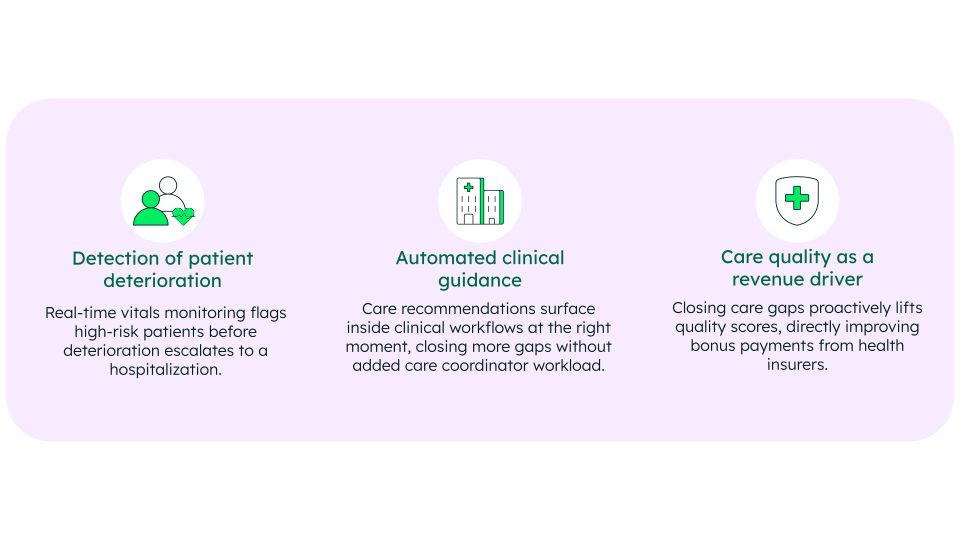
Figure 1. Benefits of real-time clinical decision support with MongoDB
Reference Architectures
This solution ingests clinical data from wearable devices and healthcare systems, routes it through a data store and an operational layer, and delivers real-time decision support to care coordinators, as shown in the architecture diagram below.
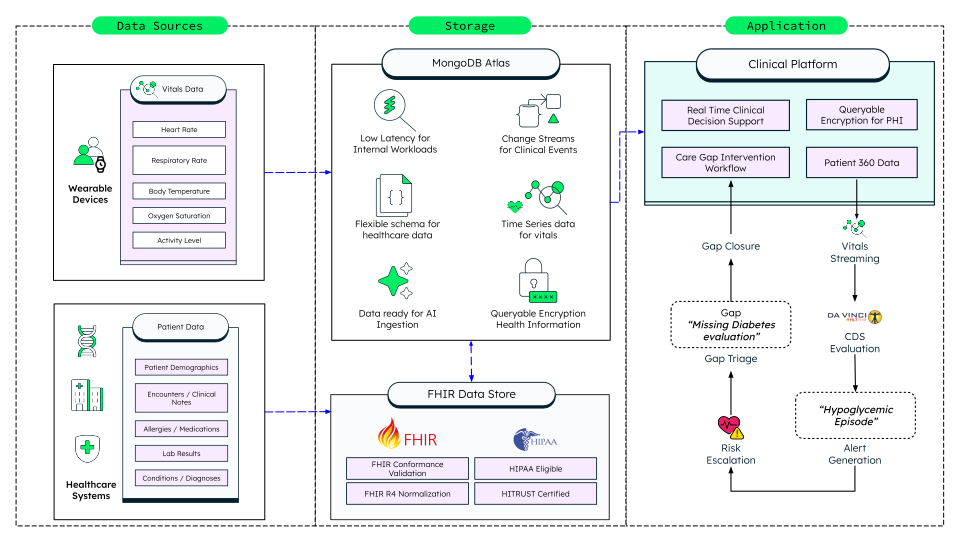
Figure 2. High-level architecture
The FHIR data store layer holds the raw FHIR R4 resources, which include:
PatientConditionMedicationRequestObservationEncounterAllergyIntolerance
This layer handles conformance validation and R4 normalization, serving as the canonical source of truth for interoperability under HIPAA and HITRUST compliance requirements.
MongoDB Atlas provides the operational layer. It stores denormalized documents and time series data optimized for the queries, aggregations, and real-time workflows required for clinical decision support.
To turn this stored clinical data into real-time action, the platform orchestrates the following components:
MongoDB Atlas serves as the operational foundation storing all clinical data in a flexible polymorphic schema.
The Data Generation Pipeline reads from the FHIR data store and populates MongoDB Atlas with patient records, vitals, and CDS rules.
The system incorporates the
AlertEngineandQualityEnginePython modules to support clinical decisions. TheAlertEnginemonitors live vitals for immediate clinical risk, and theQualityEngineevaluates clinical history for HEDIS compliance gaps. Both engines write their results to thepatient_360document in MongoDB Atlas.Finally, the care gap workflow delivers the engine’s results directly to care coordinators. For example, when the
AlertEnginefires a critical alert, the care gap workflow prioritizes open gaps so coordinators can see urgent cases first.
The following sections describe each part of this flow.
MongoDB Atlas: Key Capabilities
Designed for complex healthcare workloads, MongoDB Atlas replaces legacy systems with a highly optimized, native data ecosystem. Below is an overview of the core capabilities that enable the platform to provide real-time decision support.
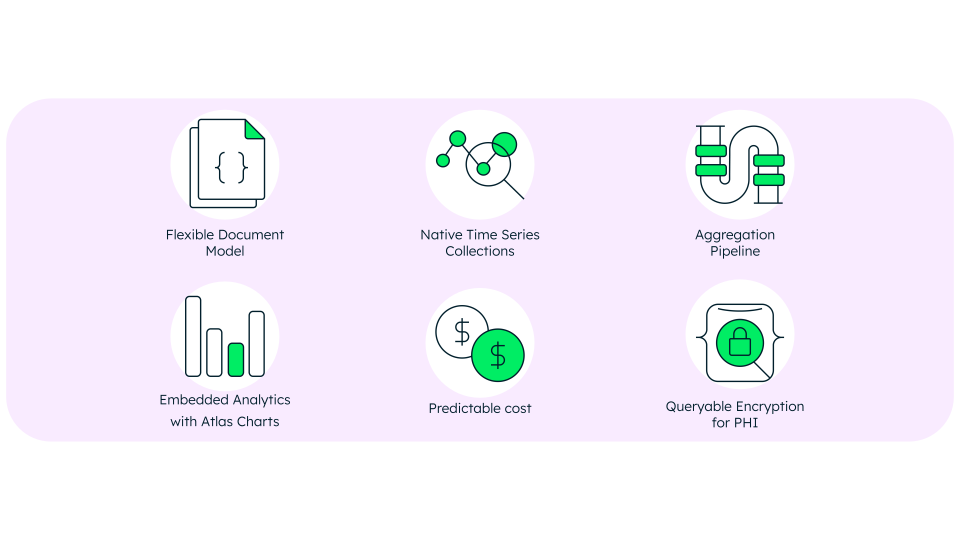
Figure 3. Atlas Key Capabilities
Flexible document model: The patient_360 collection stores a complete patient record in a single document—including demographics, conditions, medications, labs, vitals summaries, care gaps, alerts, personalized thresholds, and data provenance. A single document answers questions that would require multi-resource joins against a FHIR store.
Time series collections: The synthetic_vitals collection stores wearable device data using MongoDB's native time series collections. These collections provide automatic data bucketing, efficient range queries, and purpose-built storage for high-frequency, time-ordered data.
Change streams: The platform uses change streams to react to new vitals in real time. When a reading arrives, the system evaluates CDS rules and generates clinical alerts without polling.
Queryable encryption: MongoDB Queryable Encryption secures sensitive patient fields at rest. The application queries encrypted PHI fields without exposing plaintext, meeting HIPAA requirements and eliminating the need for a separate encryption layer.
Aggregation pipeline: This framework handles dashboard aggregations, care gap computation, vitals trend analysis, and HEDIS scoring, resolving complex clinical queries in milliseconds.
Structure for AI and analytics: The patient_360 document delivers normalized clinical facts, structured evidence, and metadata provenance to downstream AI and analytics pipelines without additional transformation.
The Data Generation Pipeline
Upon initialization, this solution uses a multi-step pipeline to seed and activate the CDS system, illustrated below.
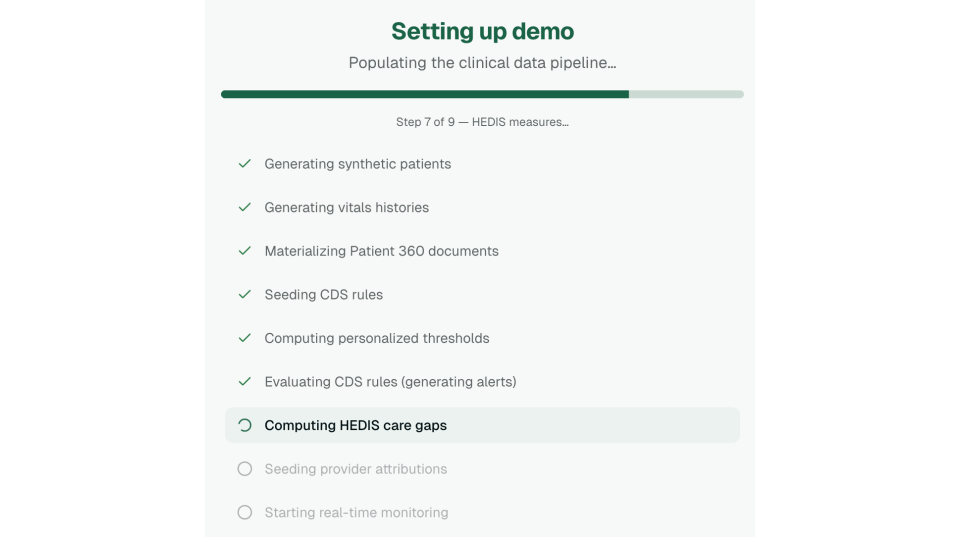
Figure 4. Data Generation Pipeline
The Data Generation Pipeline drives the initialization sequence which creates synthetic and materialized clinical data, computes personalized thresholds and care gaps, and starts the real time monitoring. The pipeline works as follows:
Generates FHIR patient bundles: Creates FHIR R4 transaction bundles including conditions, medications, lab observations, encounters, and allergies. It stores these bundles in the FHIR data store, which serves as the interoperability layer.
Generates vitals histories: Produces a 24-hour time series of vital signs per patient, representing normal, deteriorating, or acute physiological patterns. It stores the data in the
synthetic_vitalstime series collection.Materializes patient_360 documents: Transforms each FHIR bundle into a denormalized
patient_360document in MongoDB Atlas. The transformation includes adata_provenanceblock that links back to the source FHIR record.Seeds CDS rules: Inserts clinical decision support rule definitions into the
cds_rulescollection.Computes personalized thresholds: Calculates per-patient vital sign thresholds based on active medications and conditions. It stores these results in the
patient_360document.Evaluates CDS rules: Runs the
AlertEngineagainst current vitals and writes generated alerts to thealertscollection.Computes HEDIS care gaps: Runs the
QualityEngineagainst each patient's clinical history and writes structured care gap results to thepatient_360document.Seeds provider attributions: Generates provider-patient attribution relationships in the
attributionscollection, determining which providers receive gap results and alerts.Starts real-time monitoring: Activates the vitals simulation worker and begins streaming live vital sign data to the clinical platform via server-sent events.
The CDS Engines
CDS engines analyze patient data to provide actionable insights for care teams. This solution separates clinical monitoring from quality measure computation into two independent engines. This architectural pattern adheres to the Da Vinci initiative, an HL7 FHIR accelerator program for care interoperability, which recommends decoupling real-time alerting and HEDIS gap logic.
AlertEngine: Real-Time Threshold Monitoring
The AlertEngine evaluates incoming vitals against CDS rules and generates clinical alerts. It verifies the following CDS rules:
Beta-blocker-aware tachycardia: Assesses heart rate above personalized threshold.
Multi-factor hypoglycemia: Checks the aggregated conditions for heart rate spike, type 2 diabetes, insulin, age 65 or older, and low activity.
Chronic kidney disease metabolic acidosis: Monitors respiratory rate above 22 sustained for 30 minutes.
Sepsis warning: Controls the presence of three or more of the modified SIRS criteria, with diabetes as a risk amplifier.
Comparative context: Evaluates patient medication and condition profile to produce different severity warnings.
The AlertEngine checks sustained breaches, not single readings. It uses a 2-hour baseline window for spike detection and a 4-hour trend window for deterioration. The engine applies context to every alert, meaning the same heart rate reading generates a critical alert for a beta-blocker patient and a low-severity flag for a healthy patient.
QualityEngine: HEDIS Care Gap Computation
The QualityEngine determines whether each patient has received the clinical care required within a HEDIS measurement period. The engine targets patients with type 2 diabetes and CKD, and evaluates their clinical histories against designated HEDIS measures.
The following table shows these HEDIS measures:
Measure | Code | Evidence Required |
|---|---|---|
Comprehensive Diabetes Care — HbA1c Testing | CDC-HBA | HbA1c lab result |
Kidney Health Evaluation for Diabetes | KED | eGFR and uACR lab results |
Controlling High Blood Pressure | CBP | Qualifying encounter |
Statin Therapy for Patients with Diabetes | SPD | Total cholesterol lab result |
Eye Exam for Patients with Diabetes | EED | Qualifying encounter |
Care coordinators use the QualityEngine results to identify which patients need intervention and prioritize outreach before gaps affect quality scores and reimbursements. Each result includes gap status, evidence found, evidence missing, recommended action, priority score, and a recompute date. Additionally, the engine exposes a FHIR compliant endpoint that returns a MeasureReport bundle to ensure interoperability with payer systems.
Care Gap Workflow
The care gap workflow serves as the systematic process healthcare organizations use to identify, track, and resolve discrepancies between a patient's actual clinical care and established medical guidelines. The care gap detection follows a structured path from identification to closure consisting of these actions:
Evaluate: The
QualityEngineassesses each patient's clinical history against HEDIS measure criteria.Write: The system writes open gaps to the
patient_360document, along with their supporting evidence, recommended action, and priority.Review: Care coordinators review open gaps in the clinical platform, sorted by priority and overdue period.
Intervene: For actionable gaps such as KED and CDC-HBA, the platform opens a structured intervention workspace where the coordinator orders labs, records completion, or schedules follow-up.
Close: When the intervention completes, the gap status updates in the
patient_360document and theQualityEnginere-evaluates on the next cycle.Escalate: When the
AlertEnginedetects a clinical alert, it elevates the priority of related open gaps and notifies the care team. Alerts without a related gap, like a sepsis warning, route directly to the care team as independent clinical notifications.
Data Model Approach
A FHIR R4 transaction bundle for a single patient contains more than 20 individual resources. To determine if a patient over 65 with type 2 diabetes who takes insulin is at risk of hypoglycemia, the system must:
Query the FHIR store to retrieve a
Patientresource.Correlate that resource with multiple
ConditionandMedicationRequestresources.Apply rule logic across the combined result.
Under live production workloads, this traversal adds latency and produces unpredictable query times. For example, patients in this solution can have up to five active conditions, six medication resources, eight lab observation resources, an encounter, and a clinical note, all of which a CDS rule must evaluate.
To bypass this overhead, the patient_360 document consolidates this fragmented data into a single document, eliminating the traversal entirely. All clinical data for a single patient lives in one document structured as follows:
patient_id: Unique patient identifier linked to the source FHIR record.demographics: Age, gender, and encrypted PHI fields (name, MRN, date of birth).conditions: Active diagnoses with SNOMED codes and onset dates.medications: Active prescriptions with dose, route, and frequency.labs: Results with values, units, and reference ranges.flags: Computed booleans derived from conditions and medications.personalized_thresholds: Per patient vital sign limits based on active medications.vitals_summary: Latest readings, 4-hour averages, and 24-hour trends.active_alerts: CDS alerts generated by theAlertEngine.care_gaps: HEDIS measure results computed by theQualityEngine.data_provenance: source FHIR collection, patient ID, and materialization metadata.
Clinical Data as Document Arrays
In the patient_360 document, each condition represents an entry in the conditions array, while each medication represents an entry in the medications array. As shown below, the document stores clinical entities in the shape they are used, rather than splitting across separate tables:
{ "conditions": [ { "code": "44054006", "display": "Type 2 diabetes mellitus", "clinical_status": "active", "onset_date": "2017-10-21T21:29:59.716351+00:00" }, { "code": "433144002", "display": "Chronic kidney disease stage 3", "clinical_status": "active", "onset_date": "2023-09-12T21:29:59.716372+00:00" } ], "medications": [ { "display": "Insulin glargine 100 units/mL injection", "dose": "20.0 units", "route": "subcutaneous", "frequency": "once daily at bedtime", "status": "active" }, { "display": "Atenolol 50 mg oral tablet", "dose": "50.0 mg", "route": "oral", "frequency": "once daily", "status": "active" } ] }
Computed Operational Fields
The FHIR bundle contains standard interoperability data, whereas the patient_360 document incorporates operational fields that FHIR does not define, including clinical flags, care gap results, personalized thresholds, and active alerts.
For instance, the materialization pipeline, embedded within the broader Data Generation Pipeline, computes clinical flags from the FHIR bundle and writes them directly to the patient_360 document. The AlertEngine reads these flags to determine which CDS rules apply to a patient, including:
flags.has_beta_blocker: Activates the beta-blocker heart rate rule.flags.has_insulin: Activates the multi-factor hypoglycemia rule.flags.has_ckd: Activates the CKD metabolic acidosis and respiratory rules.flags.condition_codes: SNOMED codes for all active conditions.
Care gap results use the same approach. The materialization pipeline computes care gap results and appends them directly to the patient_360 document. Each computed HEDIS measure is stored within the care_gaps array along with its associated status, priority, evidence, and recommended_action. Unlike standard FHIR, the document model stores this information alongside the patient's clinical record. An example of this structure is shown below:
{ "care_gaps": [ { "hedis_measure": "CDC-HBA", "measure_name": "Comprehensive Diabetes Care — HbA1c Testing", "status": "open", "days_overdue": 34, "priority": "high", "evidence": { "found": ["HbA1c 5.13% (2025-10-07)"], "missing": [] }, "recommended_action": "Schedule or order an HbA1c follow-up" } ] }
This approach offers additional flexibility; when clinical requirements change, you can extend the document. New CDS rules write new fields to the same document without affecting existing ones.
Traceability to the Source Record
The patient_360 document constitutes a derived operational view, not a replacement for the FHIR record. The materialization pipeline produces this view from the FHIR resources. To audit any clinical decision or care gap result, every document includes a data_provenance block:
{ "data_provenance": { "layer": "cds_operational", "source_fhir_collection": "synthetic_patients", "source_patient_id": "1b3bbaec-def8-4b55-8e87-9d04b55d6890", "materialization_version": "1.0", "last_materialized_at": "2026-05-09T21:30:04.873754+00:00", "fhir_resource_count": 22 } }
The FHIR data store remains the canonical source of truth for interoperability, whereas MongoDB Atlas holds the operational view, maintaining a direct link back to its source data.
Encrypted Fields Within the Document Model
Healthcare regulations require applications to encrypt PHI. A common approach involves storing encrypted PHI in a separate system and retrieving it only when needed. However, this framework introduces a second data store, a separate key management layer, and increased latency to every patient record fetch.
MongoDB Queryable Encryption eliminates this overhead keeping PHI in the same document. It secures highly sensitive fields, such as the patient's name, MRN, and date of birth, making them readable only to authorized client applications with the encryption key. The remainder of the document remains queryable for operational use:
{ "demographics": { "name": { "$binary": { "base64": "EAXZmoXjO0re...", "subType": "06" } }, "given": { "$binary": { "base64": "EF1RChFVFEJC...", "subType": "06" } }, "family": { "$binary": { "base64": "EK18iT8qVki8...", "subType": "06" } }, "birth_date": { "$binary": { "base64": "EJOsqgLJPEjI...", "subType": "06" } }, "gender": "female", "age": 77 } }
For example, microservices like the AlertEngine and QualityEngine read flags, thresholds, and care gap fields, neither reads the encrypted demographic fields.
Build the Solution
Find detailed installation instructions in the GitHub repository. The repository includes steps to obtain a MongoDB Atlas connection string, Docker configurations for containerized deployment, and instructions for local deployment.
Configure the prerequisites and setup
Install Docker Desktop to run the platform as containers.
Create a MongoDB Atlas M10 cluster and configure network access.
Connect to your Atlas cluster and copy the connection string.
[Optional] Create an AWS account with access to the
HealthLakeservice if you want to persist FHIR bundles in an external FHIR data store.
Launch the platform and data seeding
Open http://localhost:8080 in your browser. At login, choose the persona that matches your demonstration scenario:
Frida (Simulation Mode): Select Frida to configure simulation settings before seeding. The platform runs a multi-step pipeline that generates and loads all data automatically. Use this mode for a live demonstration with real-time vitals streaming.
Diego (Existing Data Mode): Select Diego to connect to a previously seeded dataset with no simulation running. Use this option when you want to demonstrate the platform against stable data or when the seeding pipeline has already run.
Explore the patient dashboard, review open care gaps, and monitor vitals in real time.
Key Learnings
Use MongoDB Atlas as the operational layer for FHIR workflows: Extend the application's FHIR data foundation with a denormalized operational layer in MongoDB Atlas to power real-time clinical queries, care gap computation, and vitals monitoring.
Model patient data as a single document: Store conditions, medications, labs, alerts, care gaps, and vital sign thresholds together in one document, enabling your application to retrieve everything it needs in one read, without joining multiple resources.
Precompute clinical flags and thresholds at data ingestion: Extract key clinical facts from FHIR bundles and store them as computed fields in MongoDB Atlas at ingestion time, allowing CDS engines to evaluate rules without re-reading source records.
Write care gap and alert results directly into the patient document: Use array fields like
care_gapsandactive_alertsto store HEDIS measure results and clinical alerts alongside the clinical record, providing care coordinators with complete, actionable information in one query.Protect PHI with MongoDB Queryable Encryption: Apply queryable encryption to sensitive patient fields to secure PHI while avoiding plaintext exposure, meeting HIPAA requirements without a separate encryption layer.
Authors
Giovanni Rodríguez Fragoso, MongoDB
Francesc Mateu Amengual, MongoDB
Diego Canales, MongoDB